
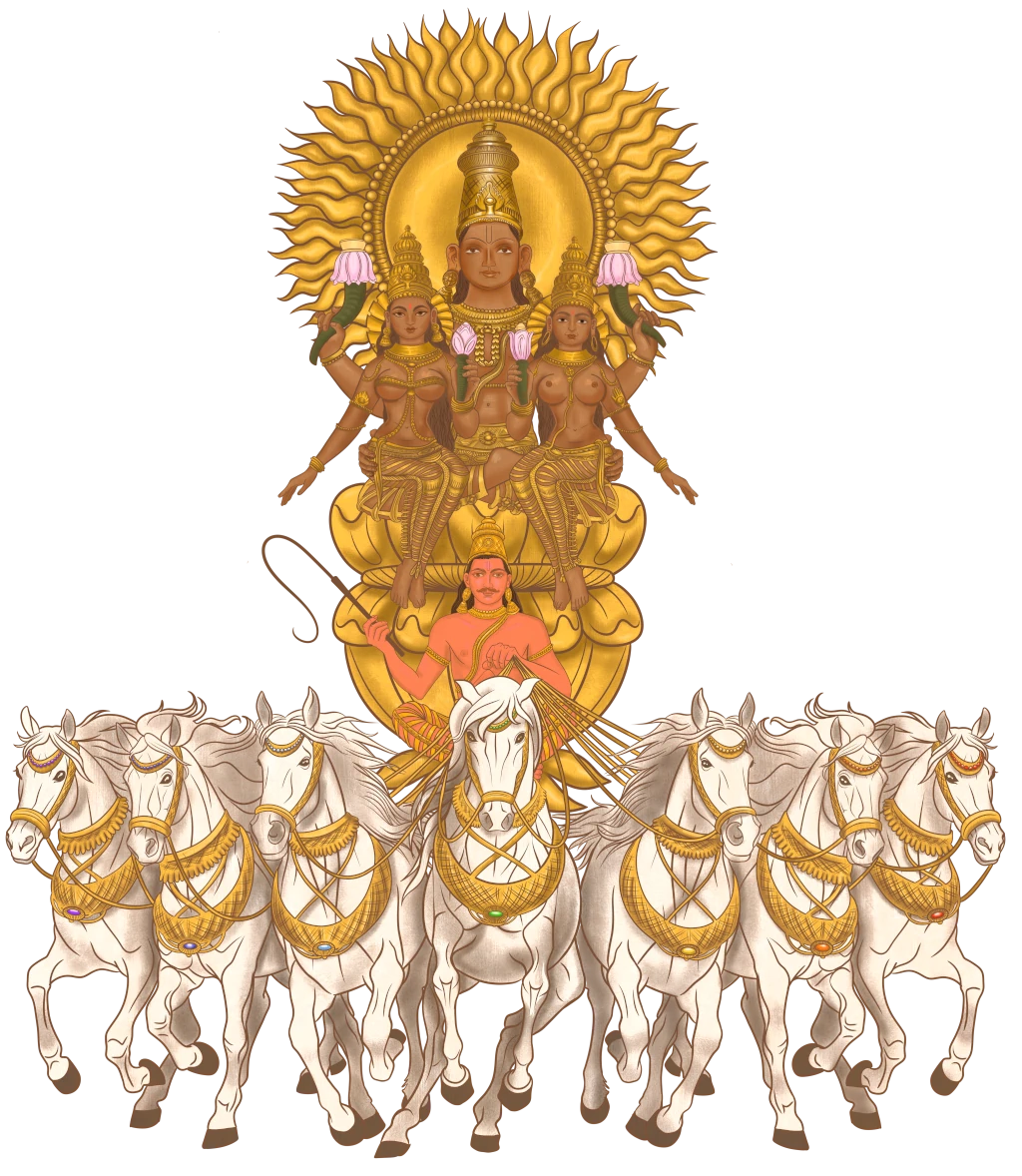
SŪRYA DEVA
Sūrya is one of the Sanskrit terms for the Sun, and deva translates to God. The Sun God is the personification of the Absolute (brahman) and the chief deity (iṣṭa–devatā) for many followers of Hinduism. Brahman is considered the Supreme Reality that exists beyond above everything else.
This is the Absolute Reality, which is eternal and unchanged. Brahman, though in itself inexpressible, it exists as sat – ćit – ānanda, meaning existence – consciousness – happiness. It is immanently present in all creation. At the same time, the transcendentality of the absolute existence means that it goes beyond the limits of material and sensual cognition – beyond the possibility of experience on a subtle and mental level.
Sūrya Deva is referred to in the Hindu tradition as ādi deva, which means the First God or the Supreme God. It is one among all direct manifestations of Self-Existent Being, which is fully visible for people. His existence does not require additional evidence because everyone can have their own direct experience (pratyakṣa) of the existence of His light, warmth that maintains the energy of life. Of course, physically the Sun, as a celestial body shares some characteristics and attributes that are assigned to Brahman, but they are not be understood through the scope of astronomical or physicochemical characteristics. This form of discovery cannot be seen as exhaustive in the experience of the Absolute. When we speak of the Sun rising, setting, covered by clouds, etc, we speak from the level of human perception. In reality, the Sun neither rises or sets, nor is it covered by anything. All of these perceptions of the Sun are conditioned by our limited time, space and existence on Earth. The same applies to scientific research methods. Only through spiritual practice, one can gradually remove the veil of ignorance and realize Brahman. Then Bhagavān Sūrya becomes known in personal experience, beyond the ability of its expression; and sat – ćit – ānanda becomes a part of the enlightened Soul.
Bhagavān is the honorary title used within Hindu tradition and is a theological term for the Eternal Soul (parabrahman), expressing its perfection, majesty and central role in the universe. The Bhagavāna are characterized by six perfect and immutable virtues (ṣāḍguṇya):
- jñāna – absolute knowledge;
- śakti – absolute energy;
- aiśvarya – absolute sovereignty;
- bala – absolute power;
- vīrya – absolute manlinees;
- tejas – absolute illumination.
Because of these six attributes Lord Sūrya is called Bhagavān. The Sun God is also known as the Ruler of the Nine Planets (navagraheśa). The nine planets (navagraha) refer to heavenly bodies and deities within Hindu astrology (jyotiṣa), which affect people’s lives through managing the effects of their deeds (karma). These nine planets are:
- Sūrya – The Sun represents power, and the energy of life.
- Ćandra – The Moon represents emotion, mind and intuition.
- Maṅgala – Mars, associated with courage, energy and action.
- Budha – Mercury, symbolizes intelligence, communication and commerce.
- Bṛhaspati – Jupiter, associated with wisdom, knowledge and spiritual development.
- Śukra – Venus, represents love, beauty and pleasures.
- Śani – Saturn, symbolizes discipline, responsibility and karma.
- Rāhu – The north node of the Moon, also known as the Dragon Head, associated with desires, ambition and materialism.
- Ketu – The southern node of the Moon, and is also called the Dragon Tail. Ketu represents spiritual growth, withdrawal from material desires and karmic lessons.
Traditionally, the God Sūrya is described as moving on a one-wheel chariot pulled by 7 mares, which represent the 7 colors of the rainbow, the visible light spectrum, 7 days of the week and 7 main energy centers in our body (ćakra). His coachman is Aruṇa, the God of Dawn with a reddish shade of skin, symbolizing the beginning, hope and new opportunities that every day brings. In ancient Vedic texts there are detailed descriptions of the Sun relating to the construction of the universe, including the speed with which he moves in his chariot through space (antarikṣa).
In ancient Vedic texts, Sūrya is described as Āditya, the son of Āditi – the goddess (devī) of heaven and mother of the gods. The Father of the Sun God is the sage Kaśyapa – the god of knowledge and wisdom. The numerous siblings of Sūrya Deva are mentioned in many texts, such as: Bhāgavata Purāṇa, Viṣṇu Purāṇa, Ṛgveda, Yajurveda, Śatapatha Brāhmaṇa or Mahābhārata. These texts mention seven, eight or twelve celestial brothers and ten celestial sisters. They also refer to the various expansions of the Absolute, manifesting itself in the form of goddesses and gods, personifying many of His aspects and attributes. Below is a list of the 12 Āditya – the 12 Suns shining in each of the 12 months of the year, along with their spheres of influence:
- Varuṇa – God of the sea and sky.
- Mitrā – God of friendship and contract.
- Āryaman – God of honor and nobility.
- Bhaga – God of prosperity and wealth.
- Dakṣa – God of justice and order.
- Aṃśa – God of parts and contributions.
- Tvaṣṭṛ – God of blacksmithing and craftsmanship.
- Savitṛ – God of the Sun and life.
- Pūṣan – God of protection and care.
- Śakra – God of thunder and storms.
- Vivasvat – God of sunlight and illumination.
- Mārtāṇḍa – God of the sun and life.
In addition to spheres of influence, the Holy Scriptures mention four other brothers of the Sun. They are: Yama – the God of death and ruler of the kingdom of the underworld. Vāyu – God of the air and winds. Vāmana – the 5th incarnation of the God Viṣṇu, who brought back cosmic order. Indra – the god of war, rain & thunder. He is the king of the devas – within the heavenly kingdom of the gods. These are the sister’s of the Sun, written within the Vedic texts. Each one is a goddess (devī):
- Diti – Goddess of darkness and chaos, the mother of demons (Dānava), enemy of the Adityas.
- Dānu – Goddess mother and patroness of demons known as Dānava, enemy of the gods.
- Kāla – Goddess of time and death.
- Kapilā – Goddess of the red bull, patroness of warriors, philosophers and thinkers.
- Sinīvālī – Goddess of conception and fertility, a patroness of women and children.
- Anumati – Goddess of favor and prosperity, associated with the moon and the lunar cycle.
- Rākā – Goddess of abundance and music, associated with the full-moon and its influence on humanity.
- Krodha – Goddess of strife and anger.
- Prabhā – Goddess of light and radiance.
- Ārćiṣ – Goddess of sunlight, associated with spark and light.
According to tradition, the Sun God is also known as Sūrya Nārāyaṇa; and has many wives. Every wife – goddess (devī) – represents a feminine aspect of the Supreme (brahman) in the form of His Power (śakti) and is important due to its role and relation to Sūrya Deva within the universe. The following is a list of goddesses followed by a description of their character:
- Sāraṇyū also known as Saṃjñā – Goddess of dawn, consciousness, perception and senses.
- Ćhāyā – Goddess of shadow, symbol of mystery and the hidden aspects of life.
- Prabhā – Radiant goddess of light, splendor and solar energy.
- Nalīnī – Goddess of the lotus, the Power of Varuṇa Deva, a symbol of beauty, purity and spirituality.
- Vimalā – Goddess of purity, brilliance and bliss.
- Arūṇā – Goddess of the red, morning light, wisdom and intellect.
- Suvarṇā – Goddess of gold, symbol of beauty and luxury; and also of darkness and coldness.
- Rohinī – Goddess of love, symbolizes fertility and abundance. Identified with one of the lunar constellations.
- Taptī – Goddess of warmth, water and fertility. The personification of the river Tapti in India.
- Vivasvatī – Goddess and mother of Mānu, the first human. Vivasvatī symbolizes wisdom and integrity.
- Suvarćhalā – Goddess symbolizing light and warm of the Sun, associated with the planet Venus, also believed to be the goddess of love and relationships.
According to some sources, Sūrya Deva also had other less known wives – goddesses (devī) that are listed below. These are a few examples:
- Kuntī – Goddess symbolizing motherly love, devotion and moral dilemmas that arise during difficult situations in life.
- Marīcī – Goddess of light, energy and creativity. She supports mothers and is a guardian of children.
- Sūryavallī – Goddess of the sun, symbolizing care and protection from bad influences.
- Bhadrā – Goddess of good, happiness and prosperity. She is a form of Lakṣmī (goddess of fortune).
- Subhadrā – Goddess of beauty, associated with the solar energy.
- Ravī – Goddess of the sun and its corresponding energy of time. From this goddess, the Sanskrit word for Sunday (ravivāra) originates.
- Uma – Goddess of love, beauty, homesteading and family. Mostly known as the wife of Śiva, but in certain traditions she is presented with Sūrya Deva as the mother of the god Kumara (kumāra) – the god of the moon and war.
In accordance with ancient truths, Sūrya and his wives became parents of many children. Below is a list of some of their children:
Vaivasvata Manu – The seventh of fourteen fathers of humanity. According to tradition, he lives in the present manvantara. After the great flood, he survived with his family and seven wise men (saptarṣi), and gave birth to the current human race. Vaivasvata Manu is a key figure in Hindu cosmology, responsible for creating and establishing the laws and norms governing the functioning of society.
Yama – the first human being who died and became the God of death and justice. Yama is the ruler of the underground Kingdom of Naraka, which is a hellish World. This is where he judges the dead and guides them according to their merits or faults to be reborn under various conditions, to reap the consequences of their actions. Yama symbolizes the inevitability of death and the law of karma. He is also responsible for justice and moral order in the universe. He is the twin brother of the goddess Yamī.
Yamī – regarded as the the favorite child of Sūrya Deva, she is the twin sister of the god Yama. She is also known as Yamunā. She is the personification of one of the mostly sacred rivers in Hinduism. It is believed that bathing in or drinking from her waters can remove sins, cleanse and heal. Yamī symbolizes femininity, fertility and sexuality. She is believed to the first woman. In some Hindu texts, Yamī is presented as the wife or lover of Yama and tries to convince her brother (Yama) to extend the family lineage. Sometime after his death, Yamunā, the sacred river became one of the eight main wives (aṣṭabhāryā) of Krishna (kṛṣṇa).
Aśvin – Hindu twin brother gods and are known as the Aśvin Kumāra. They are benevolent deities who help humans and animals. They care for them, heal them and assist them in difficult situations. They are associated with medicine, health and education. They are commonly called the divine doctors. Defined as saviors (nāsatyā), they are an example of brotherly love and loyalty. Nāsatyā is also a term for two stars found in the Gemini constellation. Those two stars symbolize the two brotherly deities.
Revanta – The youngest child of the Sun God. He is the leader of the Guhyakas – supernatural dwarven beings guarding treasures and hidden riches of the Earth. Revanta is depicted as a handsome young man often shown on horseback or in a chariot. Revanta symbolizes strength, speed, courage and freedom. He is worshiped as a patron of travelers. He is also believed to be the guardian of forests, mountains and wild animals.
Śani – Also known as Śanaiśćara. He is the divine personification of Saturn – one of the nine planets (navagraha) in Hindu Astrology. He is the deity guarding the laws karma (the law of cause and effect), justice and retribution for actions expressed in the form of thought, speech and deeds. Śani is responsible for fulfilling human fate of misfortune, sorrow, old age discipline, limitations, responsibilities; and any delays. His positive influence provides leadership, authority, humility, longevity; as well as honesty and wisdom born from experience. Śani symbolizes spiritual asceticism, penance, discipline, and conscientious labor.
Tapati – A goddess, symbolizing cleanliness, light and wisdom, presented as a beautiful woman of golden skin. She is also associated with energy, fertility and life-giving force. Her name originates from the word „tapas”, which means ascesis and heat in the spiritual sense. Because the goddess Tapati is believed to be the personification of the river Tapati, she is worshiped both in the form of a goddess, as well as in the form of a river. Her spiritual self discipline is inspiring for many followers of Hinduism, She is also presented as a defender of humility and morality, in addition to being a patron of the educated, artists and intellectuals.
Sāvarṇimanu – The eighth Manu. The father of humanity. He succeeds his half-brother Vaivasvata Manu. In Hindu tradition, each Manu rules for a cyclic period, known as a manvantara, which lasts 306,720,000 years. At the end of one manvantara, a new cycle of creation takes place in which another Manu governs. Sāvarṇi Manu symbolizes the continuity and cyclicity of the process of creating the World and the duty of establishing and enforcing laws and rules in society.
Sugrīva – A brave king of monkeys. His character is extensively described in the Rāmāyaṇa epic. Sugrīva played an important role in the epic, helping Rāma rescue his kidnapped wife from the demonic king Sītā. Sugrīva is praised as smart, loyal and brave. His wit and abilities turned out to be very helpful. With the help of Sugrīvą, Rāma finally defeated the demonic king and regained his beloved wife. After the triumph, Sugrīva became the rightful ruler of the Kingdom of Vanara. After some time, when the avatar of Viṣṇu – Rāma decided to leave the earthly world, Sugrīva also withdrew from the earth and returned to his father, Sūrya Devy.
Karṇa – Also known as Sūryaputra, the son of the Sun God and princess Kuntī, the mother of the the Pandavas brothers – the main characters of the Mahabharata. Unaware of his divine origin, raised by his foster parents, being an extremely talented and courageous warrior, Karna becomes an enemy of his own brothers in the Battle of Kurukṣetra. In Hindu tradition, it symbolizes the conflict between fate and free will. Karna’s attitude forces you to reflect on faithfulness and honor. He is one of the most complex and fascinating characters in the Mahabharata. Gifted with extraordinary skills and strength, Karna struggles with feelings of rejection and injustice. Ultimately, he dies on the battlefield at the hands of his biggest rival and brother, Arjuna. After these events, the divine Krishna (kṛṣṇa) and the other heroes of the Mahabharata worshiped Karṇa as satpuruṣa – a true, honest, good man of high morality and the best of those who understand and observe the principles of dharma.
It is worth noting that in various versions of religious tales and Hindu texts, the roles and meanings of goddesses and gods may vary. This should not be taken as a form of exclusion or inconsistency, but rather as various attempts to describe the indescribable Brahman. Truth is met exclusively within the spiritual process through many forms of practice, including – meditating on the male and female aspects of The Supreme Being. Only then, Absolute Truth sits on the throne of Love in our hearts, and becomes the Sun illuminating the darkness of ignorance.